GEO, AEO, AIO or just good SEO? What works for SaaS in 2026
The rules of search visibility are changing, and the scale of that change is hard to ignore. According to recent research, AI Overviews can cause a 15-64% decline in organic traffic, depending on the industry and search type.
Roughly 60% of searches now yield no clicks at all, as AI-generated answers resolve the query directly on the results page.
Google’s AI Overviews have also displaced top-ranked links by as much as 1,500 pixels, around two full-screen scrolls on desktop and three on mobile, meaning even pages that rank well are losing visibility. For SaaS brands built on organic discovery, this is not a future risk. It is already happening.
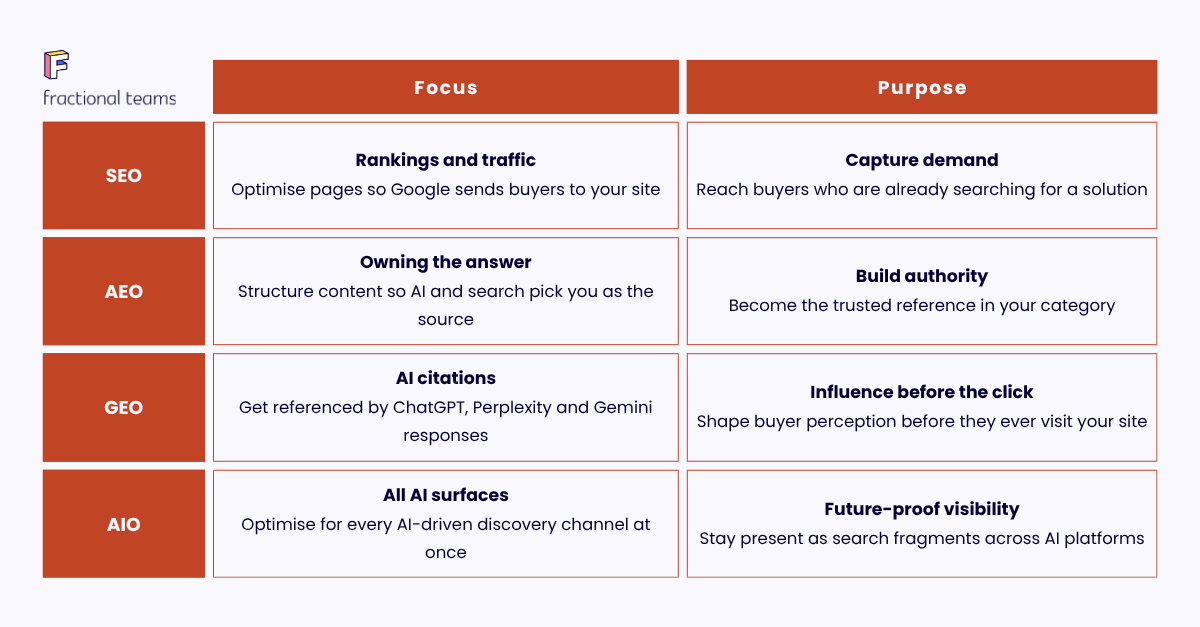
What are AIO, GEO, and AEO?
Understanding the terminology is the first step toward a coherent AI search visibility strategy.
AIO (AI Optimisation)
AIO (AI Optimisation) means optimising content to appear in or alongside AI-generated summaries, particularly Google’s AI Overviews.
GEO (Generative Engine Optimisation)
GEO (Generative Engine Optimisation) is about optimising content so it is cited or referenced by generative AI tools such as ChatGPT, Perplexity, Claude, or Gemini.
AEO (Answer Engine Optimisation)
AEO (Answer Engine Optimisation) focuses on structuring content to directly answer specific questions, so search engines and AI tools surface it as the definitive response rather than one link among many.
These terms sound distinct, but in practice, they overlap heavily, and that overlap is precisely the point.
AIO/GEO/AEO are part of a unified SEO workflow.
If previously it was simply SEO, now it can all be called content optimised for SEO/AIO/GEO/AEO. This is the new reality and adapting content to modern tasks is a must.
Nick Anisimov, Founder, FirstHR
The goalposts have not moved as dramatically as the buzzword churn implies. The fundamentals still apply. What has changed is where and how users consume search results.
A note of honest scepticism
Not everyone is buying the AI search revolution narrative, at least not yet. Most GEO strategy content recycles the same four points: use tables, use lists, structure your data, write high-quality content.
The core challenges are real. Control groups are nearly impossible since AI Overviews, Perplexity, and ChatGPT are notoriously volatile and heavily personalised. Attribution is murky and the shelf life is short. Tactics that work one week can disappear the next.
Right now it is genuinely hard to separate true GEO...
Right now it is genuinely hard to separate true GEO impact from existing SEO authority or brand signals. Until there is clearer attribution for traffic coming from AI answers, most strategies will probably remain experimentation rather than proven playbooks.
Recognize SEO limitations and work around them.
My general approach to SEO these days is simply to recognize its limitations and work around them. We put some effort into SEO especially on the local level, but we do much more with social media and direct, personal outreach. We’re a B2B enterprise, so reaching out to other CEOs is an effective tool.
This is not a reason to ignore AI search. It is a reason to be rigorous and to avoid letting FOMO drive your content roadmap.
What actually works in AI search for SaaS
Specific content beats generic content
The content that gets cited by AI tools and that ranks in traditional search tends to be genuinely authoritative. Not just comprehensive in length, but specific, data-backed, and clearly written by someone who has done the thing.
For B2B SaaS and tech brands, this means resisting the temptation to publish broadly and instead going deep on the problems your customers actually face.
Use cases, integration walkthroughs, content tailored to specific personas, named competitor comparisons. This is content AI models cannot generate from general training data alone, and it is what attracts qualified buyers at the right moment.
Third-party presence beats on-site optimisation
This is the insight most GEO content avoids talking about because it is slow and hard to sell.
Brand visibility in AI answers is not determined solely by what lives on your own website. AI systems are heavily influenced by how consistently and accurately your brand is described across credible external sources, what some call entity clarity.
Third-party presence matters more than anything on your own site.
Third-party presence matters more than anything on your own site. G2 reviews, comparison articles by others, authentic community discussions. AI systems pull from these sources way heavier than your perfectly structured blog posts.
Traditional PR, review generation, and third-party coverage are more relevant than ever. A SaaS brand consistently mentioned in legitimate industry publications, review platforms, and community discussions is far more likely to appear in an AI-generated category overview than one that has only optimised its own pages.
For teams without the headcount to manage this consistently, a fractional CMO or fractional marketing team embedded in the business can drive this kind of always-on brand presence without the overhead of a full-time hire.
Structured content helps, for the right reasons
Tables, comparison pages, FAQ sections, and definition-style posts appear more frequently in AI-generated answers. But the reason is not exactly the formatting. It is that structured content is easier for AI systems to parse and verify. If your comparison page is the clearest resource on a topic, it is more likely to be cited.
Structure your content in ways that make facts easy to extract. This serves traditional SEO, featured snippets, and generative AI citations simultaneously. It is also one of the most reliable ways to optimise content for ChatGPT citations and Perplexity SEO visibility, where answer-ready formatting consistently outperforms prose-heavy pages.

How to use Reddit for brand visibility
One of the most underused levers in SaaS content strategy is also one of the most direct inputs into what AI tools actually learn.
Reddit and LinkedIn are now among the most-cited domains across ChatGPT, Perplexity, and Google AI Mode. That means your brand’s presence, or absence, in relevant community discussions directly shapes how AI systems describe your category. For a B2B SaaS or tech brand, this is not a distribution play. It is a brand visibility in AI answers play.
The challenge is that Reddit is not a distribution channel in the traditional sense. Communities police promotional content aggressively. The brands that win on Reddit show up consistently, contribute genuinely, and build a presence before they ever need it.
The real value from Reddit is not just visibility. It is the language buyers use to describe their problems, the objections that come up before purchase, and the competitors being compared against you. This intelligence directly informs a stronger Reddit marketing strategy for SaaS and feeds into the broader AI search visibility strategy that increasingly determines whether your brand gets cited or ignored.
We built a Reddit Community Research Hub in Notion that maps relevant subreddits, tracks recurring themes and questions, and helps teams turn community intelligence into content briefs. You can grab the template here:
Final takeaways
AIO, GEO, and AEO are not revolutions. They are evolution. The SaaS content strategy that wins in 2026 combines authoritative, specific content with a consistent presence across the sources AI tools actually learn from: third-party reviews, community platforms, industry publications, and earned media.
The tactics change. The fundamentals do not.
Is your SaaS brand navigating AI search visibility?
Whether you need a fractional CMO to lead the strategy or a fractional marketing team for B2B tech to execute it, we would love to hear what you are working on. Get in touch.
Dariia Panchenko
Hi! I'm Dariia Panchenko, Analytics and Community Manager at Fractional Teams. I write about the best B2B marketing strategies and practices.