How to rank in AI search with GEO

More buyers are using ChatGPT, Gemini, and Claude to evaluate software and build vendor shortlists.
If a prospect asks an AI engine to compare options for your category, does your brand show up? If it does, is the AI using your positioning or your competitors’ narrative?
Data from this Ahrefs study shows Google still sends roughly 345x more raw traffic than ChatGPT, Perplexity, and Gemini combined, with AI sending just 0.1% of total web referrals.
However, while click volume is small, intent is massive. Ahrefs found that AI-assisted visitors convert at up to 23x higher rates than traditional search traffic because users do their research directly inside the chat interface.
If your brand is missing from those answers, you lose out on key sales opportunities.
AI visibility also adds up over time. Companies building their online presence today are teaching these models to view them as market leaders. Once a competitor takes over recommendations for your target questions, winning those spots back gets much harder.
Let’s look at how traditional search and AI discovery actually differ, and how you can position your brand for both.
Search Engine Optimisation (SEO) is the practice of improving your website so it appears higher in Google, Bing, or other search engine results when people search for topics related to your business. The main goal is to get people to click on your link in the search results and visit your website.
How search engines work
Key SEO strategies
Generative Engine Optimisation (GEO), sometimes called AEO or LLMO, is the process of getting your brand cited, recommended, and accurately described inside AI-generated answers. This includes AI assistants like ChatGPT, Claude, and Google AI Overviews.
In simple terms, GEO is SEO built specifically for AI search tools. To learn more about how these shifts affect software growth, read our guide on GEO and SEO for SaaS in 2026.
Winning brand recommendations inside ChatGPT, Gemini, and Claude requires shifting from traditional keyword targeting to a three-step GEO framework.
Instead of targeting broad educational terms like “What is CRM?”, map out the exact, high-intent questions your buyers ask when building a vendor shortlist.
AI engines pull facts from content structured specifically for data extraction. Create and update these core assets on your site:
Because AI search engines rely on third-party consensus, up to 90% of your recommendations will originate from external sites rather than your own domain.
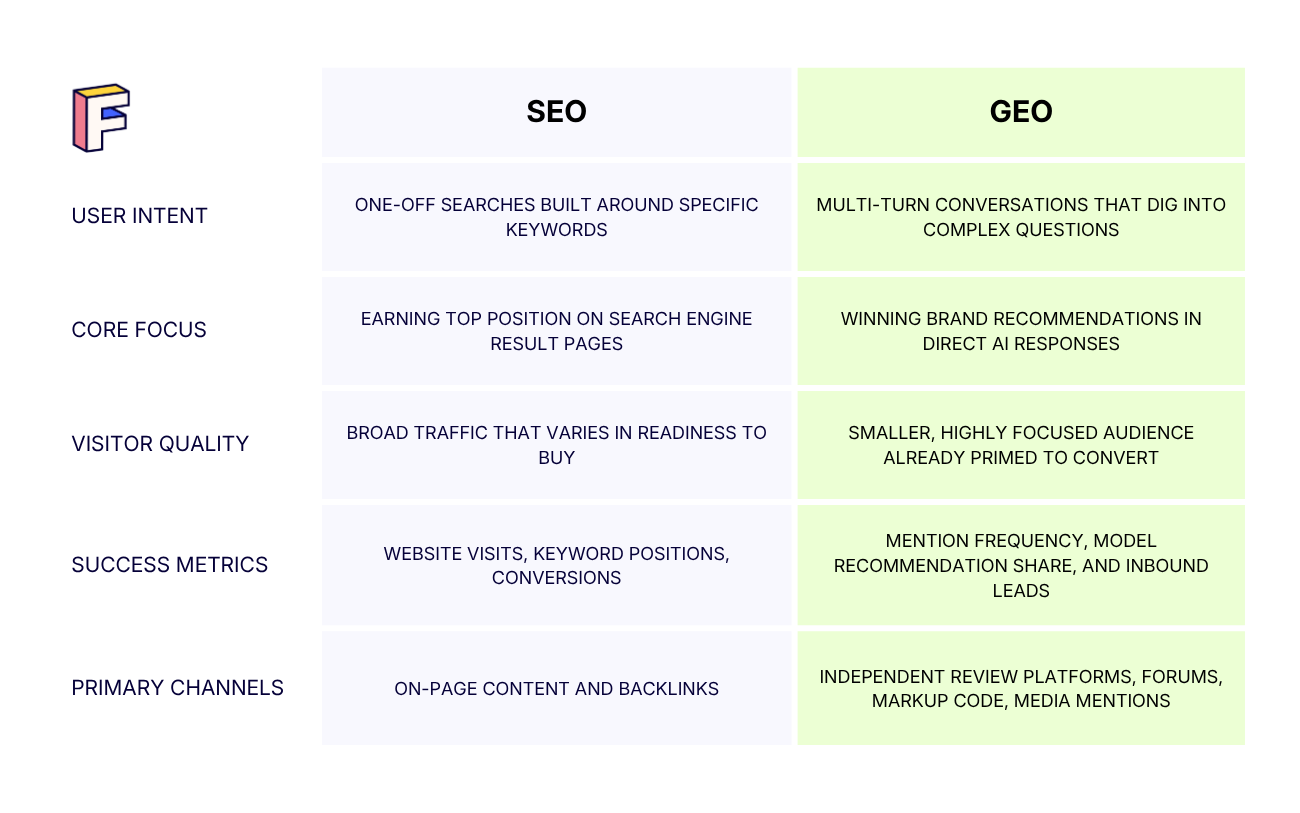
Traditional SEO helps your website rank higher on search engines like Google, so people click through to your site. GEO (Generative Engine Optimisation) focuses on earning brand mentions, recommendations, and citations directly inside AI search tools like ChatGPT, Gemini, Claude, and Perplexity.
You can track AI visibility in three main ways:
AI models are trained to find authentic human consensus. Because active forum discussions, unbiased user reviews, and hands-on advice represent real customer experiences, AI search engines heavily weight these platforms when building vendor recommendations. To learn how to execute this effectively, check out our Reddit Growth Playbook for practical tactics on building community presence.
A zero-click search happens when an AI tool answers a buyer's question right inside the chat window, so they don't even need to click on a website. With traditional search, zero-click searches feel like a missed opportunity because nobody visited your site. But with AI search, it is all about getting on the buyer's radar. Being named as a top recommendation inside the answer builds trust immediately, putting your product on the buyer's shortlist long before they ever set up a sales demo.
Earning top spots inside AI search tools takes more than basic optimisation. Fractional Teams connects you with dedicated digital content specialists and strategic fractional CXO leadership to run prompt audits, build off-site citations, and scale your GEO strategy fast.
Digital content
Events and community
Products and propositions
Fractional CxO
Lead and demand generation
Commercial and analytics
Technical platforms and services
Cloud strategy and enablement
Tech (SaaS) vendors
Industry specialists
Service providers
Customer success stories
Resources Hub
About us
Blog